This course is FREE with an Online Subscription

Course Description

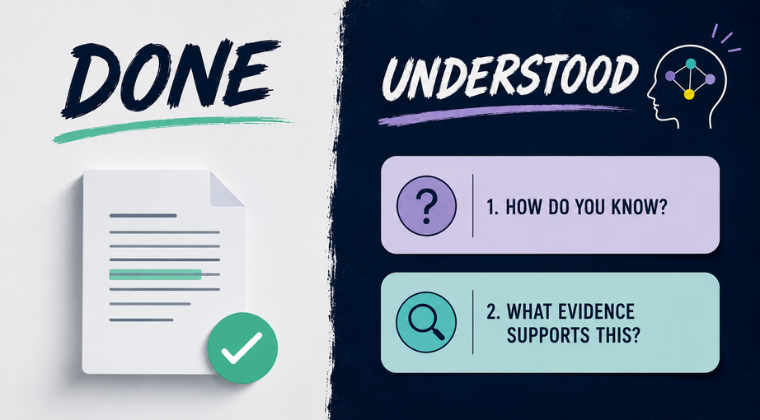
This course explores how secondary teachers can distinguish between task completion and genuine understanding during classroom learning. Teachers will examine practical strategies for checking understanding in real time, extending student thinking, and making stronger instructional decisions before moving on to new learning, with subject-specific examples from across secondary classrooms. 


Audience

Secondary Teachers


Teaching Standards

3.3.2 Proficient Level - Plan for and implement Effective Teaching and Learning - Use teaching strategies:  Select and use relevant teaching strategies to develop knowledge, skills, problem-solving, and critical and creative thinking

5.1.2 Proficient Level - Assess, provide feedback and report on student learning - Assess student learning:  Develop, select and use informal and formal, diagnostic, formative and summative assessment strategies to assess student learning


FREE with  Online Subscription

Course curriculum

  • 1

    Introduction

    • Welcome

    • Acknowledgement of Country

    • Learning Objectives

    • Teaching Standards

  • 2

    Module 1 – When “Done” Doesn’t Mean Understood

    • Before You Begin

    • Introduction

    • The Illusion of Understanding in Secondary Classrooms

    • Why This Happens in Secondary Settings – Part 1

    • Why This Happens in Secondary Settings – Part 2

    • The Core Challenge

    • Case Study: Surface Success, Hidden Gaps

    • Faculty-Specific Examples of “Done” vs Understood

    • Resource: Completion vs Understanding Diagnostic Tool

    • Reflection Question

    • Application Activity

  • 3

    Module 2 - What Understanding Looks Like

    • Introduction

    • Understanding as Disciplinary Thinking

    • Four Observable Indicators of Understanding – Part 1

    • Four Observable Indicators of Understanding – Part 2

    • What Understanding Is Not

    • Secondary Case Study: Identification vs Interpretation

    • Resource: Disciplinary Thinking Indicators Guide

    • Reflection Question

    • Application Activity

  • 4

    Module 3 – Checking Understanding in Real Time

    • Introduction

    • Real-Time Checking as Instructional Decision-Making

    • What Makes a Real-Time Check Effective?

    • High-Leverage Real-Time Checking Strategies – Part 1

    • High-Leverage Real-Time Checking Strategies – Part 2

    • High-Leverage Real-Time Checking Strategies – Part 3

    • Case Study: Real-Time Checking in History

    • AI and the Challenge of Visible Understanding

    • Resource: Quick Check Strategies Sheet

    • Reflection Question

    • Application Activity

  • 5

    Module 4 - Extending Thinking Without Over-Scaffolding

    • Introduction

    • The Challenge of Over-Scaffolding

    • Why Extending Thinking Matters

    • High-Leverage Extension Prompts – Part 1

    • High-Leverage Extension Prompts – Part 2

    • Case Study: Extending Thinking in Biology

    • Scenario Activity

    • Resource: Secondary Extension Prompt Bank

    • Application Activity

  • 6

    Module 5 - Securing Understanding Before Moving On

    • Introduction

    • Why Secondary Teachers Often Move On Too Soon

    • What Counts as “Enough Evidence”?

    • Interpreting Student Responses Precisely

    • High-Leverage Final Checks

    • Case Study: Year 10 Geography - Climate Change Vulnerability

    • Scenario Activity

    • Resource: “Ready to Move On?” Faculty Decision Guide

    • Application Activity

    • Wrap Up

    • Reference List

Features of TTA Online PD

  • Availability

    Online courses are available 24/7. Designed to be done in your own time at your own pace.

  • Money back Guarantee

    If you complete less than 25% of an online course and aren't completely satisfied, let us know, and we will cancel your enrolment and provide a full refund.